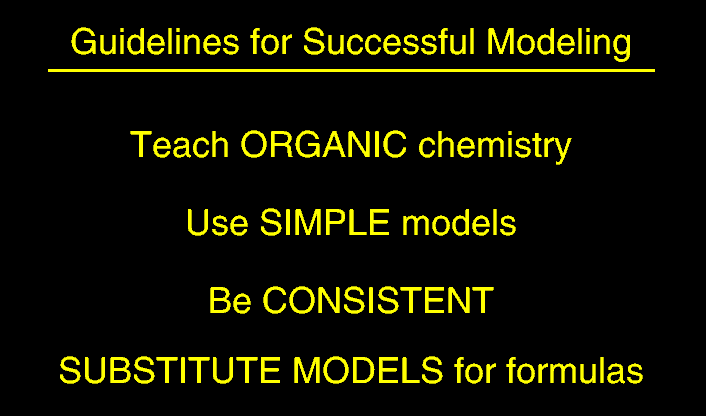
There are many modeling problems that have yet to be solved, and the best solutions will necessarily represent the unique needs of a given classroom. Even so, I think it is helpful to keep certain guidelines in mind when using molecular modeling.
Teach ORGANIC chemistry. Computer modeling programs provide a wealth of tools and features, so teachers must constantly resist the temptation to use an exotic tool that is not easily incorporated into the organic curriculum. The main goal of modeling is to help students understand organic chemistry (structure, stability, reactivity, structure-property relationships), not computational or theoretical chemistry.
Use SIMPLE models. Most of the organic curriculum is based on simple concepts: geometry, hybrid orbitals, covalent bonding, formal charge, charge and bond delocalization. Therefore, the best models are the ones that deal directly with these concepts. 95% of my model use is encompassed by the following four activities: calculating energy, calculating geometry, inspecting electron density distributions, inspecting electrostatic potentials.
Molecular orbital concepts do not currently play a major role in the curriculum, and models of MO's should be used only in a limited way.
Be CONSISTENT. By using a small number of models again and again I have many opportunities to teach students how to use a given set of modeling tools. This builds their confidence in their ability to analyze modeling data and raises the level of classroom discourse. For example, I use electrostatic potential maps exclusively to study charge distributions. I do not combine these maps with other potentially useful tools, such as atomic charges, because this would tend to confuse students.
SUBSTITUTE MODELS for formulas. When I began using models I assumed that the models were only a "bridge" to the use of Lewis structures and chemical formulas. I did not think that models enjoyed equal status as fundamental tools for expressing chemical information. I have now changed my mind. Models often convey more and better information than more traditional symbols, and should be used as appropriate. For example, in the past I might have asked students to identify the most and least polar molecules from a group of three formulas. I now think it is reasonable to show students electrostatic potential maps of the three molecules, and this practice better reflects how research chemists use models.