I first began using molecular models in my organic chemistry course 6 years ago. At that time I could only offer students "eyes-on" activities (i.e., I made models and displayed them in lecture) because I had only one computer workstation. I always assumed, however, that "hands-on" modeling activities would prove far superior to "eyes-on" activities as learning tools. Several years of experience with both activities, however, has shown me that both activities are important.
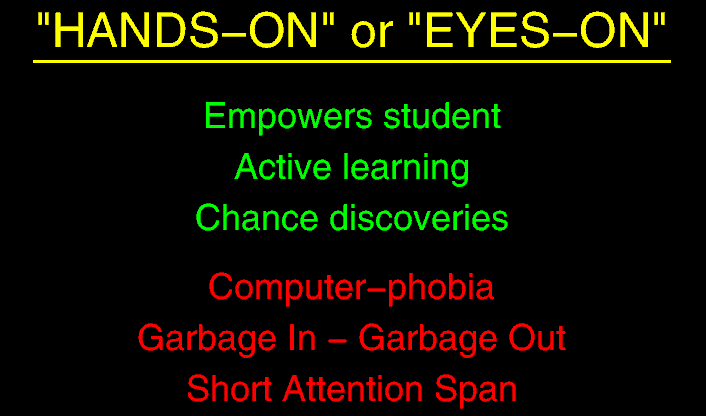
"Hands-on" modeling activities work well for all of the usual reasons. They are a reward for students who want to try their hand at modeling, and they allow students to work independently of the teacher. They also require students to be more active learners; students cannot just sit back and wait to be fed information. Finally, they provide unanticapated learning experiences, since students often make many "chance" discoveries working on their own that they would not make if a teacher was guiding their work at each step.
"Hands-on" modeling also has its downside, however. Some students still do not like (are afraid of?) using computers. Also, many students take advantage of open-ended learning situations by developing short attention spans and leaving lab early (this is particularly troublesome with molecular modeling because the models are usually only available to students actually sitting in the lab).
The worst characteristic of "hands-on" modeling is that the median level of student work is very low. This does not mean that students do poor work. It simply reflects the fact that computers need total and perfect information in order to do their job, and humans (students included) cannot be counted on to provide the necessary information. Or, to put it another way, successful modeling involves so many steps that it is often unlikely that an average student will perform all of these steps successfully. We should not expect radical changes in human behavior, so it is up to software vendors to find creative means for solving this problem. Simplified data input would be useful. It would also be useful to have "intelligent" software that can interact with students multiple times during data entry to make sure that what has been input is really correct.
Student-friendly software is desparately needed, and until it becomes available, the usefulness of "hands-on" modeling as a learning activity will be compromised.