The remainder of this paper concerns some unanticipated problems with molecular modeling activities that I have encountered.
One particularly important problem concerns a phenomenon that I refer to as "model appreciation." This refers to the fact that teachers and students often see very different things in a model.
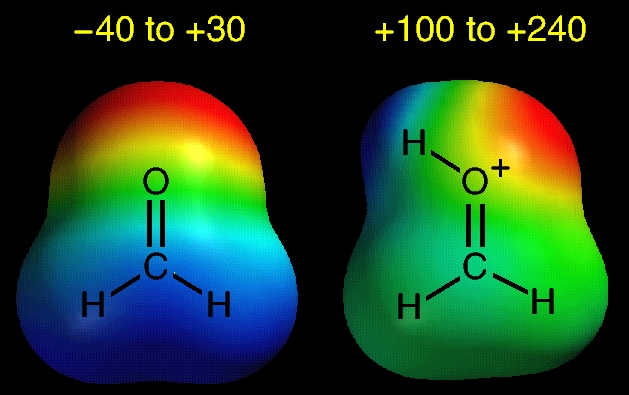
Consider the map of formaldehyde, H2C=O, shown on the left. When I look at this map I see an electron-rich O (RED) and an electron-poor C (BLUE), and what I see agrees with what I know about formaldehyde's behavior as a C electrophile. My students, interestingly, often do not "see" the electron-poor C, but identify the two hydrogens instead as the most electron-poor atoms. In this case, they are right. I have made a mistake because I have been pre-conditioned by prior chemical experience. Obviously, if I want to use this map to teach something about formaldehyde's behavior I must explain why it is incorrect to identify electrophilic atoms simply on the basis of their electrostatic potential.
The map on the right is even more interesting. It shows the cation obtained by protonating formaldehyde, H2C=OH+. Protonation makes C much more electrophilic, but students who look at this map usually conclude that protonation has made C more electron-rich (compare BLUE C in the neutral molecule with GREEN-BLUE C in the cation). The problem here is that SPARTAN is being used incorrectly.
SPARTAN always color codes the electrostatic potential map from RED to BLUE, regardless of the absolute value of the potential. The actual potential range for each map (in kcal/mol) is shown above the map. The potential on the cation's map is more positive (more electron-poor) everywhere.