Introduction from Protocol by Alexandar Galloway

"If one is to foster an understanding and awareness of how the social and the political are not external to technology, then it is important to understand how the technological is in some sense isomorphic to the social and the political

This book - Protocol - consistently makes a case for a material understanding of technology... This type of materialist media studies shows how the question "how does it work?" is also a question "whom does it work for?" In short, the technical specs matter, ontologically and politically."


Protocol p.xii


Think of other physical 'networks' prior to the Internet

  • Water
  • Gas
  • Electricity
  • Telephone
  • Cable TV
The amazing thing about the Internet is that you can transmit different kinds of data efficiently. Can your water pipes or gas lines do that?
Why?
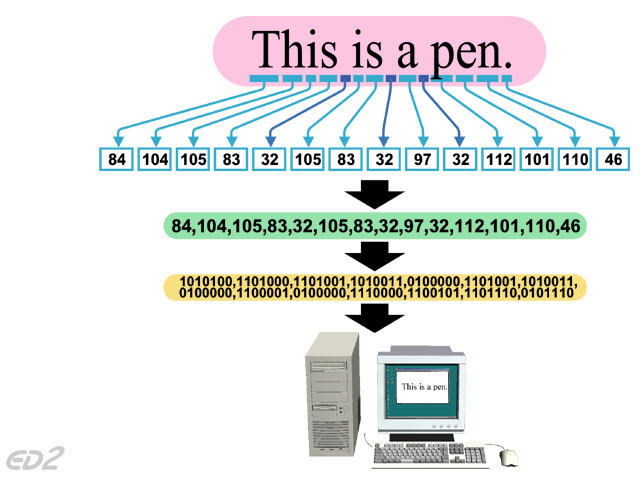
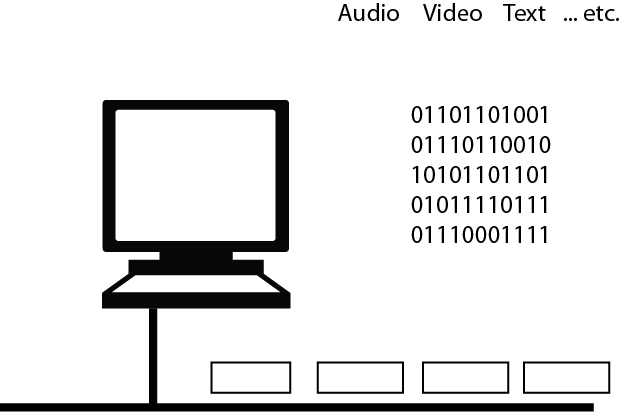
The key to having all these different traffic types on the Internet is... that these are all digital data!

What is Unique about the Internet? (compare to other physical networks)


  • Text (e-mail/data)
  • Image
  • Audio
  • Video
The amazing thing about the Internet is that you can transmit different kinds of data efficiently. Can your water pipes or gas lines do that?
Why?
The key to having all these different traffic types on the Internet is... that these are all digital data!

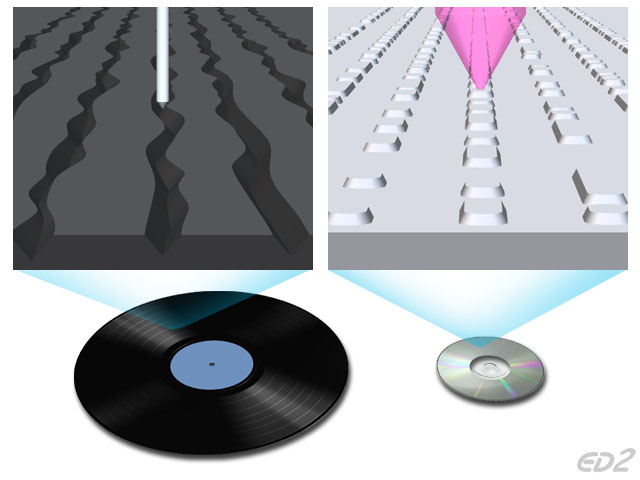
What is the difference between Analog and Digital?
Notes

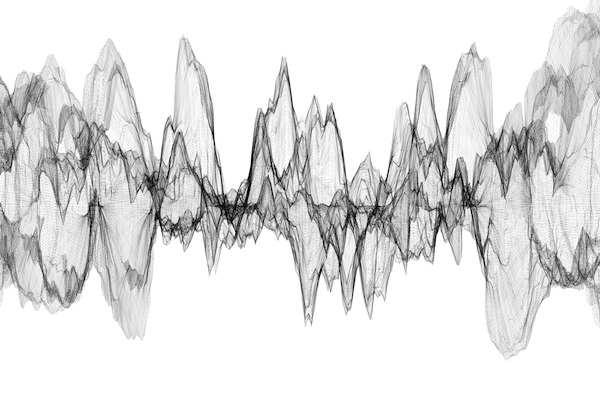
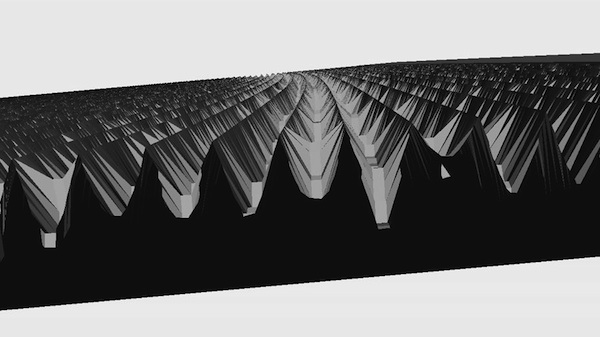
How is analog analog?

Spinning vinyl under a microscope


Notes

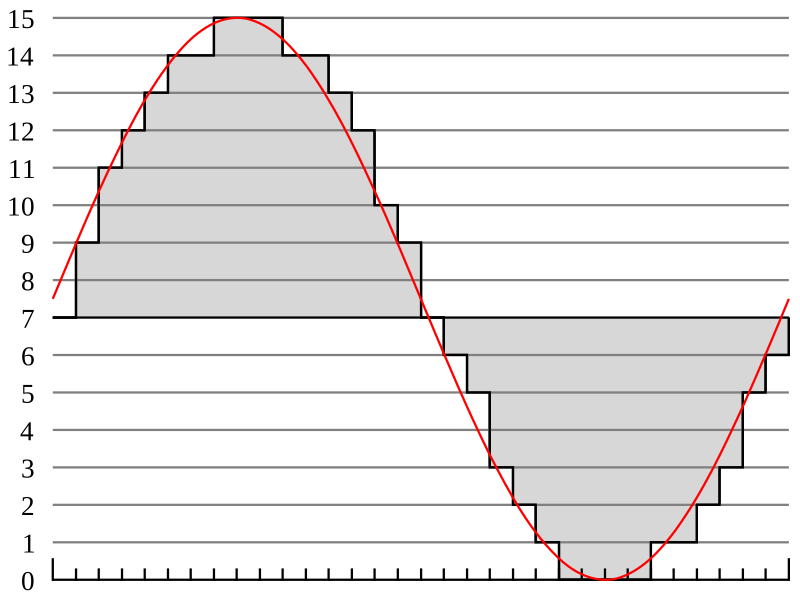
of Audio


7, 9, 11, 12, 13, 14, 15, 14, 13....


Continuous sound wave turned into discrete numbers

Why don't we hear the abrupt transitions?

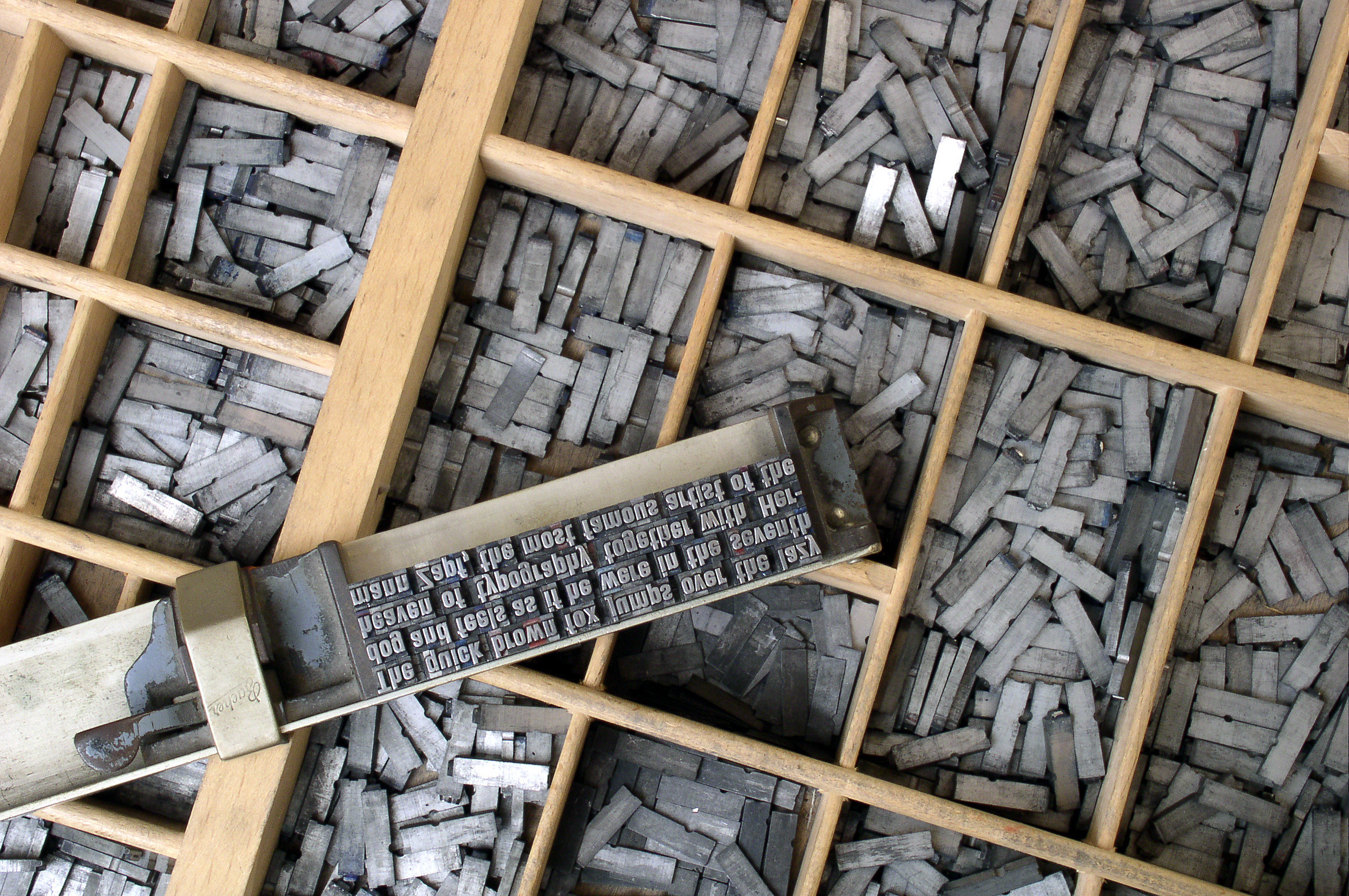
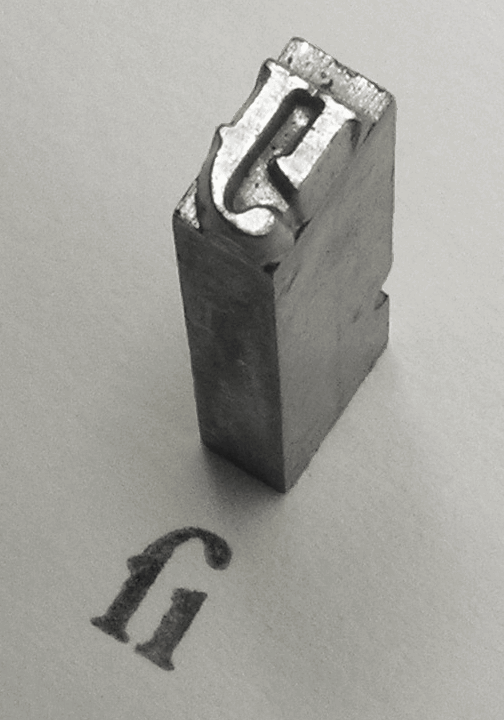
Text: Movable Type


Willi Heidelbach and Daniel Ullrich


  • Printing press breaks our experience of speech to individuated characters that may represent any phrase or sentence
  • Decentralized church power
  • Set the ground for future technology (photography to the computer) by being modular, comprising a whole from fragmented elements.

  • Moving pictures: 24 frames, pixels

    If interested, read: "Gramophone, Film, Typewriter" by Kittler


Notes: From Dani/Kittler "gramophone, film, typewriter" Atomization of the Phonetic Alphabet into movable type { - printing press breaks our experience of speech to individuated characters that may represent any phrase or sentence - decentralized church power - set the ground for future technology (photography to the computer) by being modular, comprising a whole from fragmented elements. Moving pictures: 24 frames, pixels
}

Text

Notes

Analog vs Digital

What are the properties of ?
  • continuous signal
  • analogous copy of the original signal by transferring the shape of the signal to another medium
  • noise -> signal loss and distortion (cannot distinguish between error and data)
  • imperfect copy
    • xerox copy, casette tapes, LP...?


What are the properties of ?

The internet is designed as a "digital" network.
  • discrete signal ( 9, 10.2, 12, 14.2, 10.9...etc)

  • magic of mathematics

    • noise/error -> error detection/error correction
      • the sum of all the number I am sending you is X


    • indefinite faithful copies
      • if you detect an error, resend!


    • compression
      • instead of "0000000000000000000000000000000000000000", you can say something like "fourty 0s" (much shorter)
Notes

Computer Networking 1

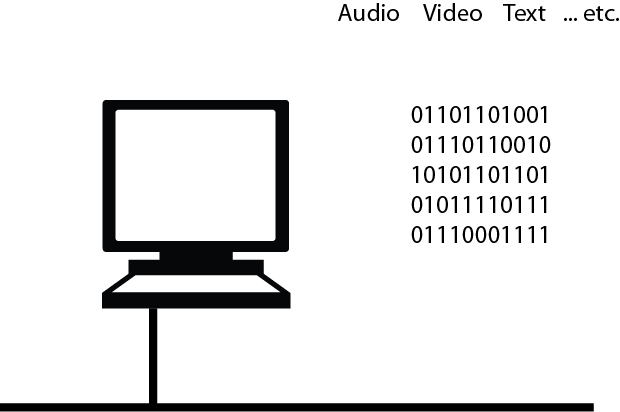
You digitize audio, video, text...etc

Computer Networking 2

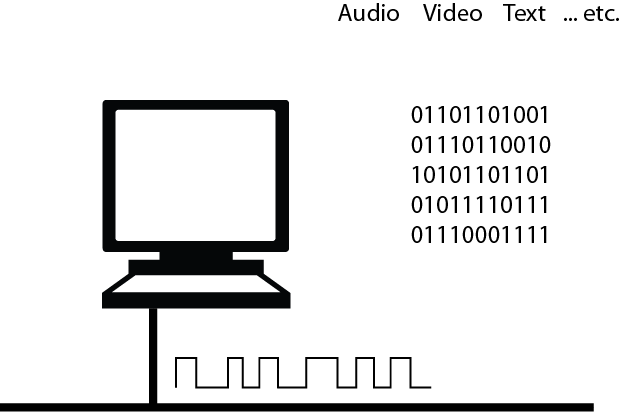
You get a sequence of binary data.

Computer Networking 3

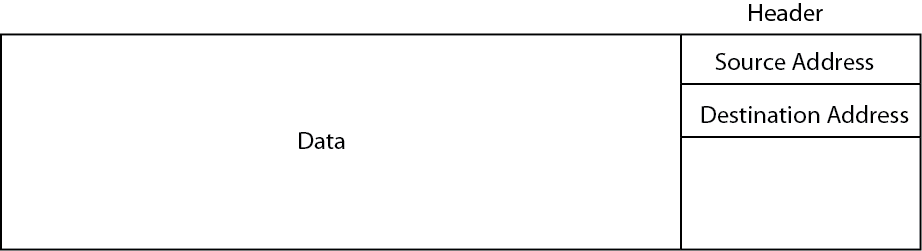
The computer splits the data in smaller chunks and sends out highs/lows on physical cables.

Questions!!

We now know how computers send out signals to the outside world.

Questions we'd like to think about: what happens when the message enters the "network"

Notes

Remember this?

Notes

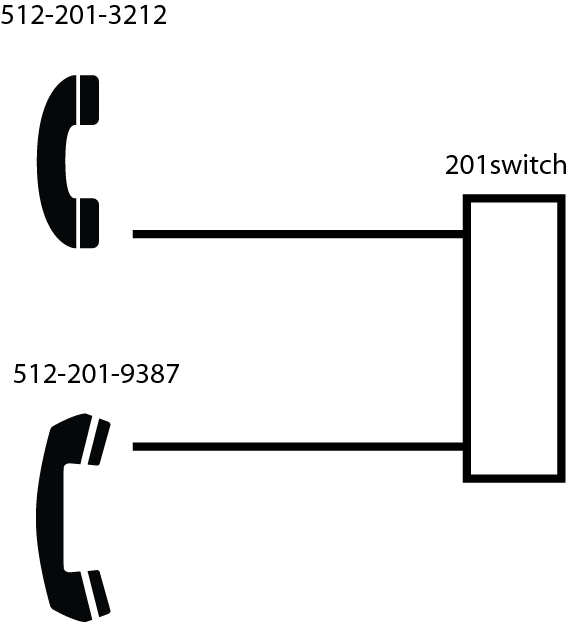
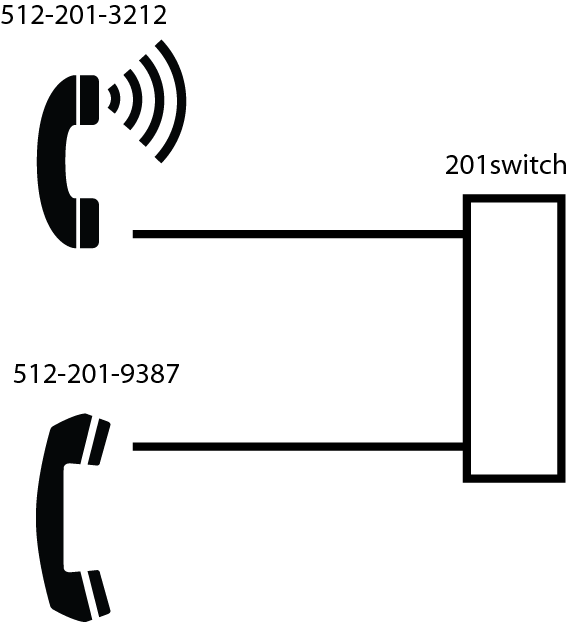
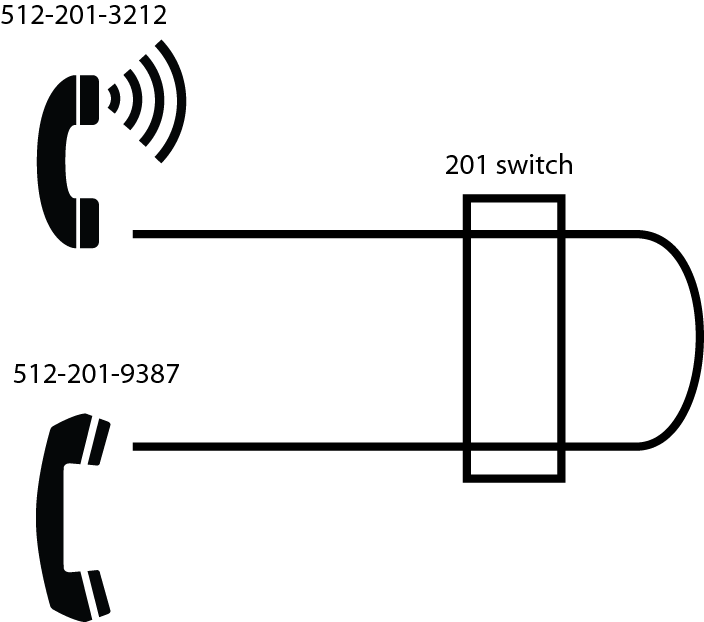
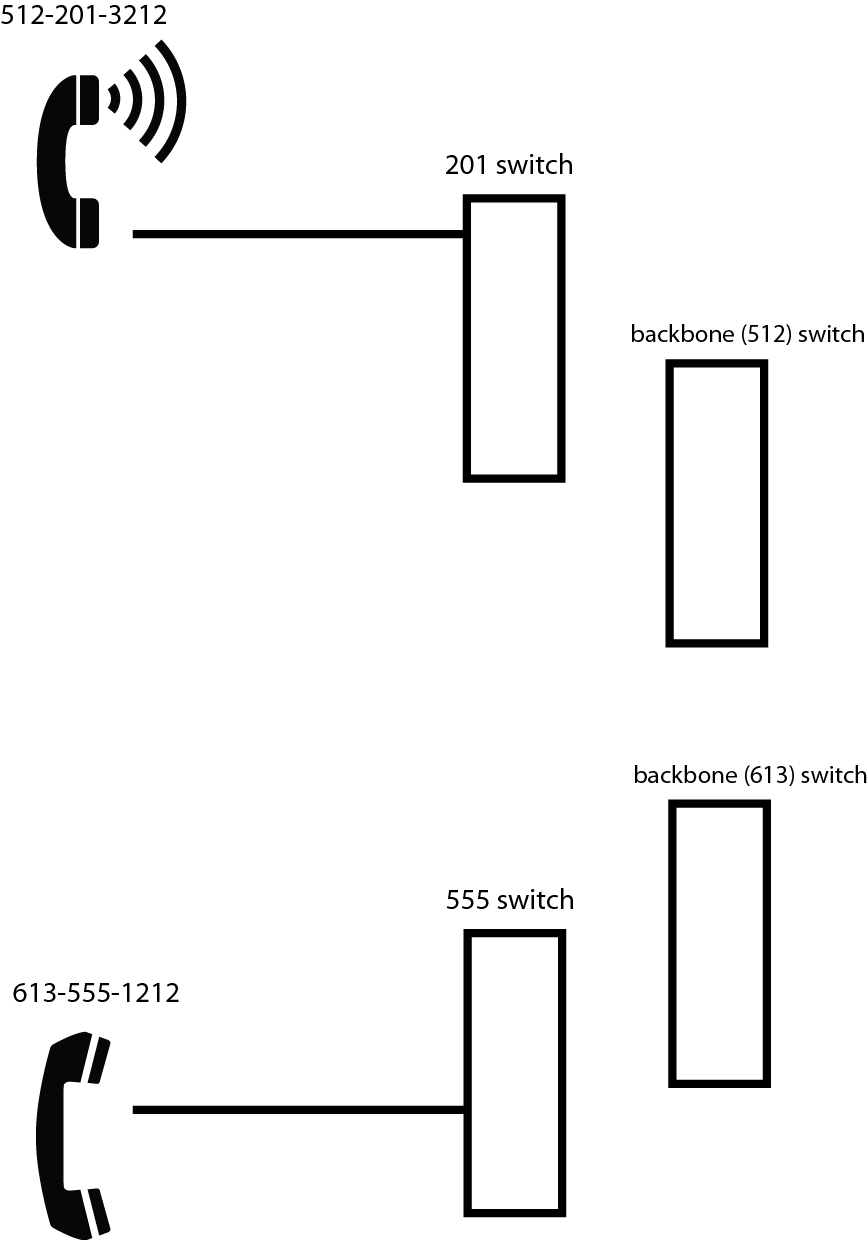
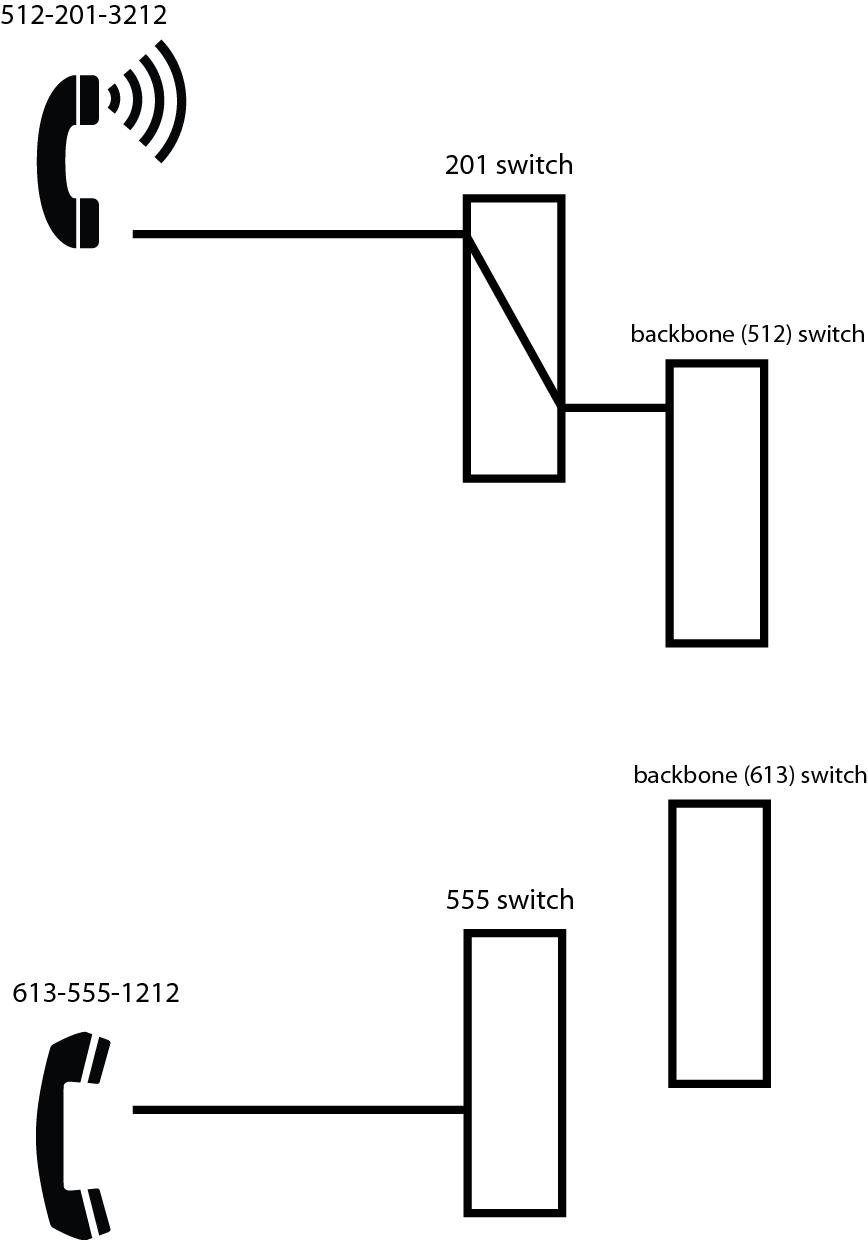
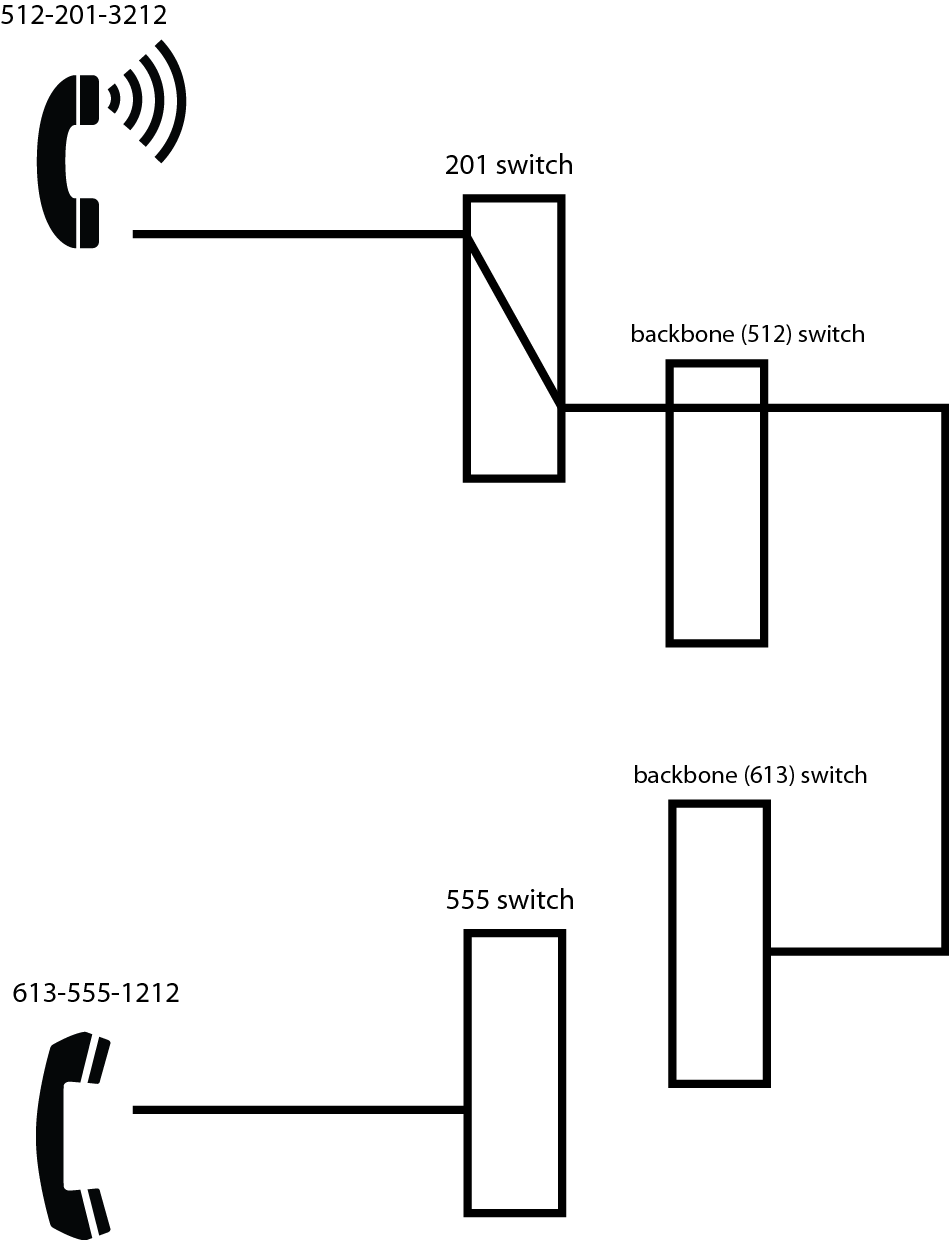
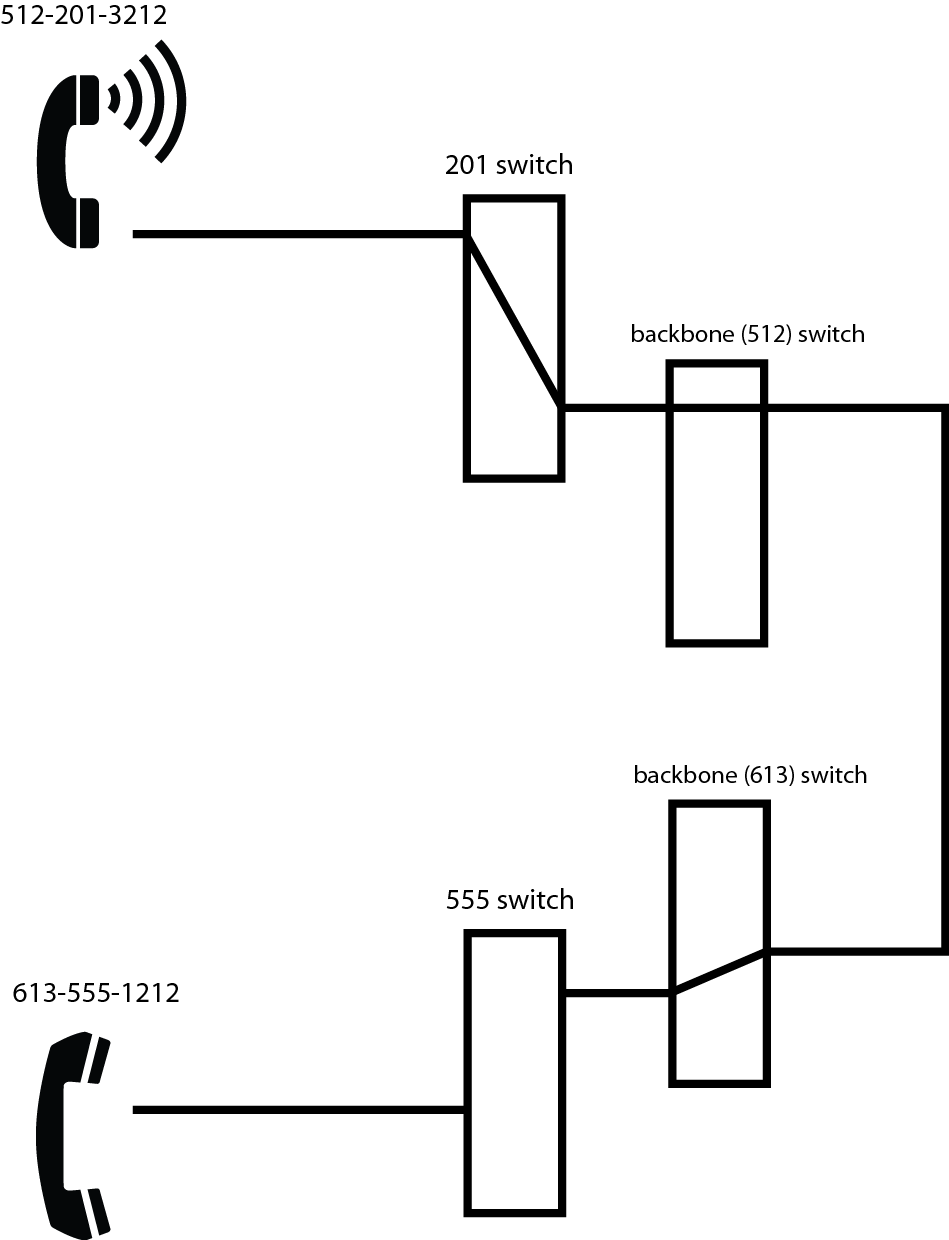
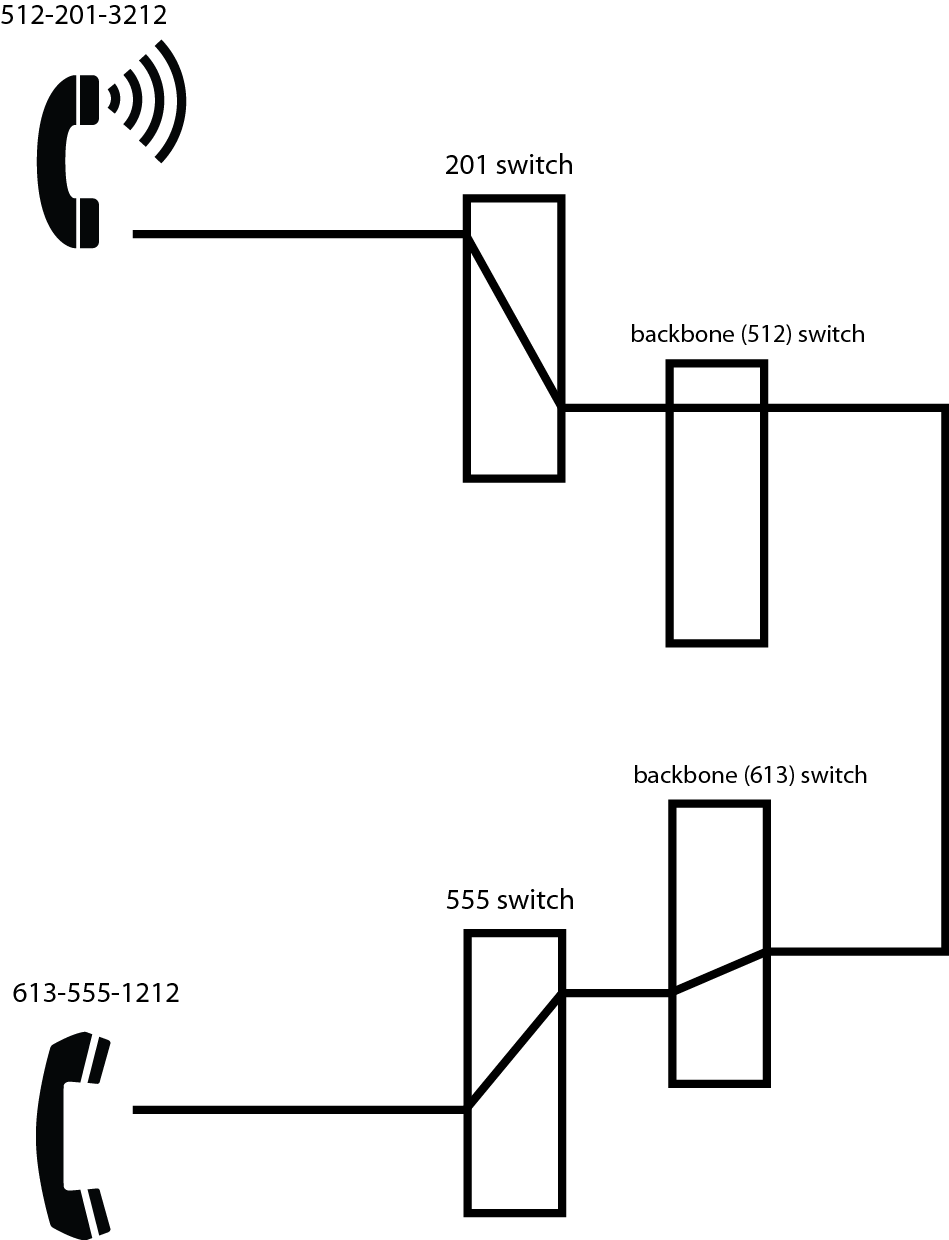
The Telephone Network: Circuit Switching, Interactive

backbone (512) backbone (613) 555 switch 613-555-1212 201 switch 512-201-3212 512-201-9387 All circuits busy
Part 1: Local Call
Notes: this is an interactive companion to the eight telephone network slides above (does not replace them). Part 1 walks through a local call (512-201-3212 to 512-201-9387), both served by the 201 switch, so the connection never leaves that one box. Part 2 walks through a long-distance call (512-201-3212 to 613-555-1212), which has to climb the hierarchy from the local switch up to a backbone switch, across, and back down to the destination's local switch. The backbone tier and the second local phone are dimmed, not hidden, when not in use, since the hierarchy is always physically present, just not always engaged. Use the "second call" toggle at the end of Part 2 to set up the contrast with packet switching later in this lecture: circuit switching reserves the entire path for one call at a time, even during silence, while the Internet's packets share links on a best-effort basis.

The Telephone Network

Notes

The Telephone Network 2

Notes

The Telephone Network 3

Notes

The Telephone Network 4

Notes

The Telephone Network 5

Notes

The Telephone Network 6

Notes

The Telephone Network 7

Notes

The Telephone Network 8


What does silence on a telephone network sound like?
Notes

Internet - Packets

One of the radical idea of the Internet was to split the data into smaller chunks called packets. Internet - Packets One of the radical idea of the Internet was to split the data into smaller chunks called packets. Packet switching, datagrams. ifconfig -a size of packets: mtu (in bytes) en0: wired en1: wireless fw0: IP over firewire

Internet - Packets 2


%ifconfig -a 
to look at MTU (packet) size (byte = 8 bits) and available interfaces
Notes

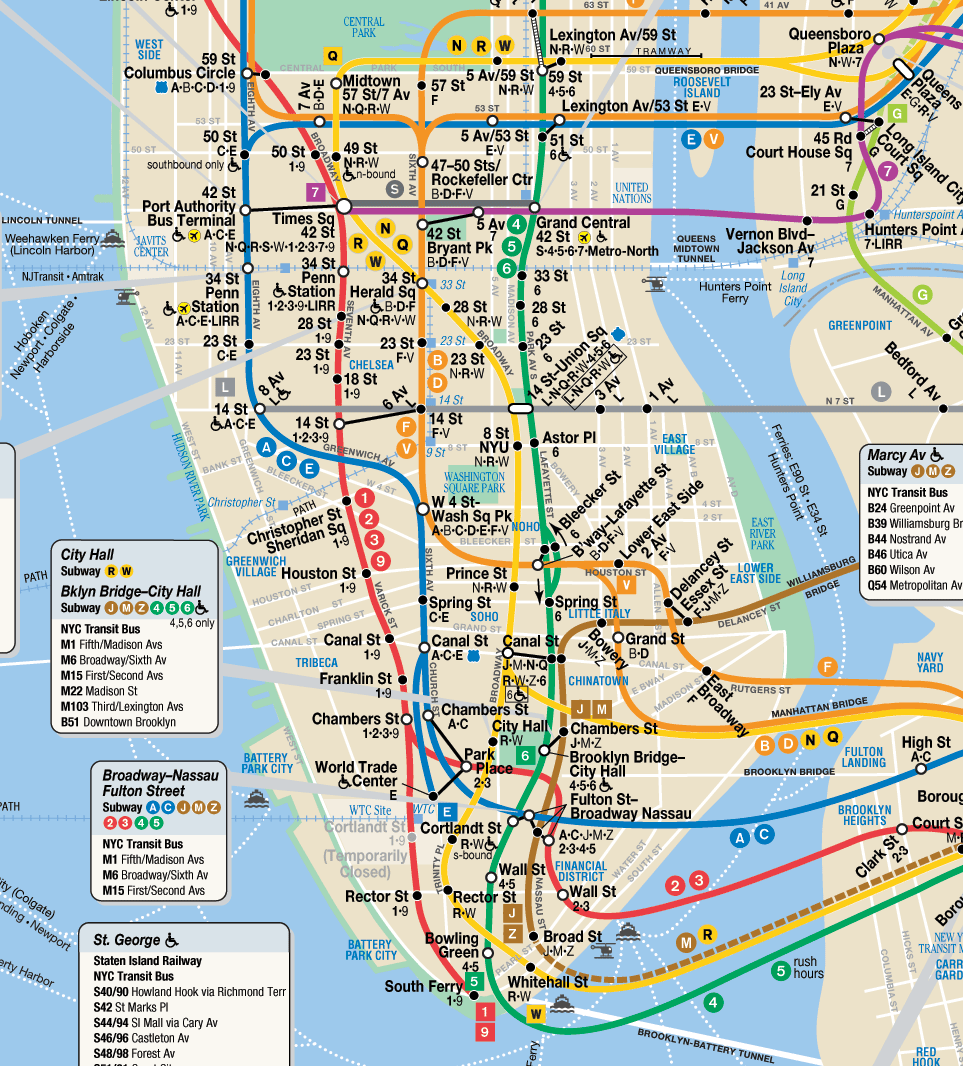
Like Navigating the NYC Subway w/o a Map


Travel from Midtown station to Broad St station (Brown line)


You are a packet. You know where you are from (SRC) and where you want to go (DST). You don't have the map of the Subway(Internet). -> Small window works. Briefly show where Broad St is. Then move to midtown and ask what they would do.
Some stations, you get off and that is it! Nothing else.
Some stations there are other lines coming in. (Grand Central has the Green line, Purple, Gray).

Navigating the NYC Subway w/o a Map, Interactive

Midtown57 St-7 Av Times Sq42 St Grand Central42 St Union Sq14 St Chambers St Fulton St Broad St 5 Avwrong way
N,Q,R,W S Shuttle 4,5,6 1,2,3 J,Z 7

Routing

Navigating packets to their destination is called routing.

Imagine the subway system with each line (red, yellow, brown...etc) independently administered. Each line knows about its own stations and where it connects with other lines.

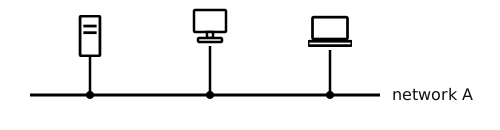
Diagram of three network nodes, a laptop, a desktop, and a server

When nodes under the same administrative domain are connected, they constitute a network.

Diagram of a server, desktop, and laptop connected on a single line labeled network A

Routers (= transfer stations)

A router is a special node connected to multiple networks, like a transfer station (Times Square) connected to multiple lines (Red: 1,2,3, Yellow: N,Q,R,W, Gray: S shuttle).

A router forwards packets between networks, e.g. from network A to network B, the way a transfer station lets you switch from one line to another.

Any node with more than two network interfaces can be a router, just as any station with more than two lines can be a transfer station.
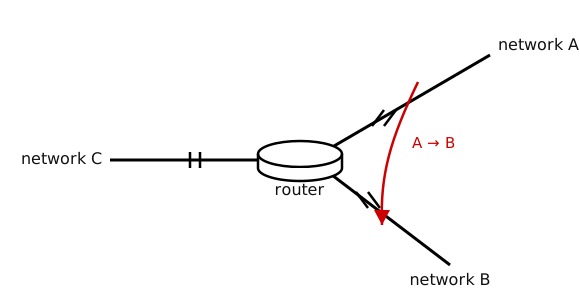
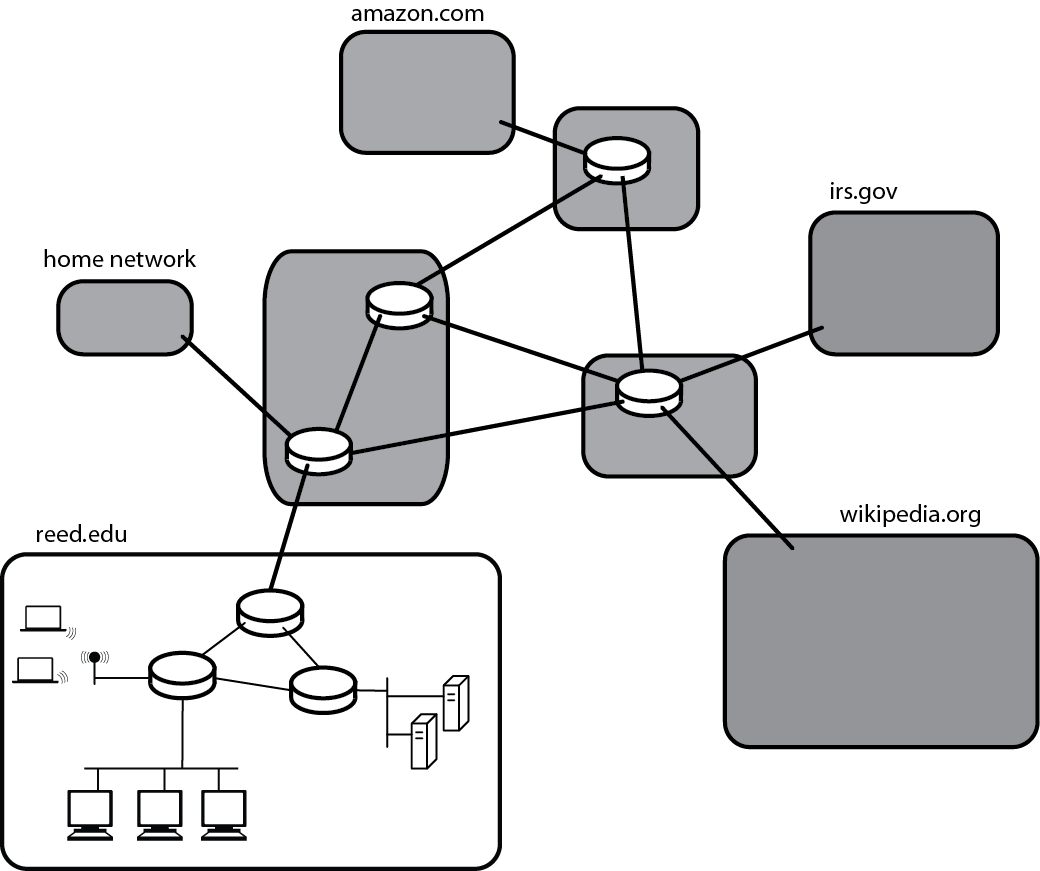
Diagram of a router connected to network A, network B, and network C, with a path highlighted from A to B
Notes

Routing 2


Looking up routing table using a UNIX command
%netstat -r
Routers know a lot - it's kind of like a station in the Yellow line knowing every station on the yellow line.

The Internet

The Internet is a network of networks, each with a different administrative domain

The Reed network is administrated independently of Wikipedia.


Notes

Questions?

What are the strengths/weaknesses of the Internet system as compared to the telephone network?
p11 a telephone network - switching is concentrated and hierarchical. calls go first to a local office, then on to a regional or national switching office if necessary. each user is connected to only one local office and each local office serves a large number of users. Thus destroying a single local office would cut off many users from the network.
small inexpensive lower quality links and compensate for failures
- message switching to packet switching

Characteristics of the Internet

- Resilient
- No central control
- Best effort
- Small inexpensive lower quality links are welcome and are allowed to fail


- Military Effort (ARPA) in a Cold War environment
- Often mentioned as designed to survive a nuclear attack.
- Resilient against physical attacks. Perhaps not so to virtual/cyber attacks.
Notes

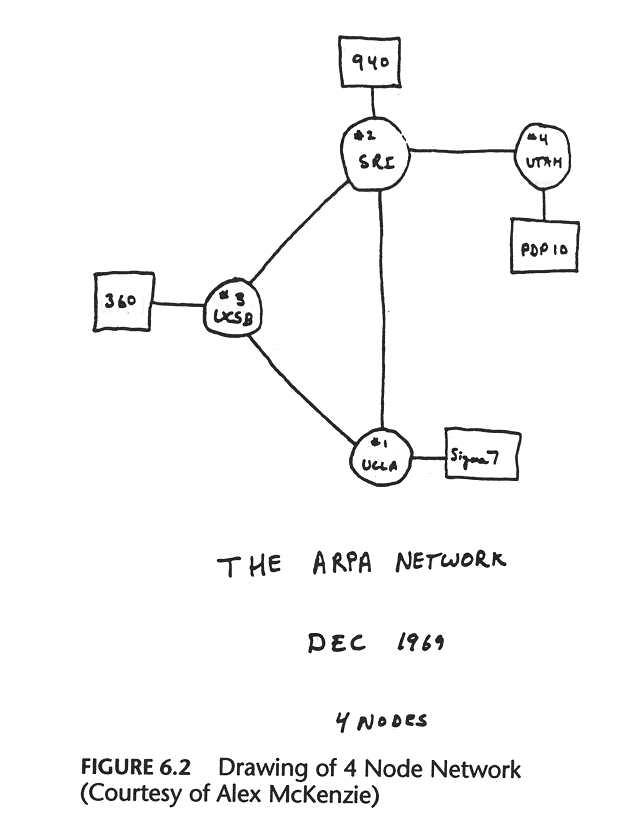
The Internet (Dec. 1969)


What are the questions one could ask through this diagram?
Notes

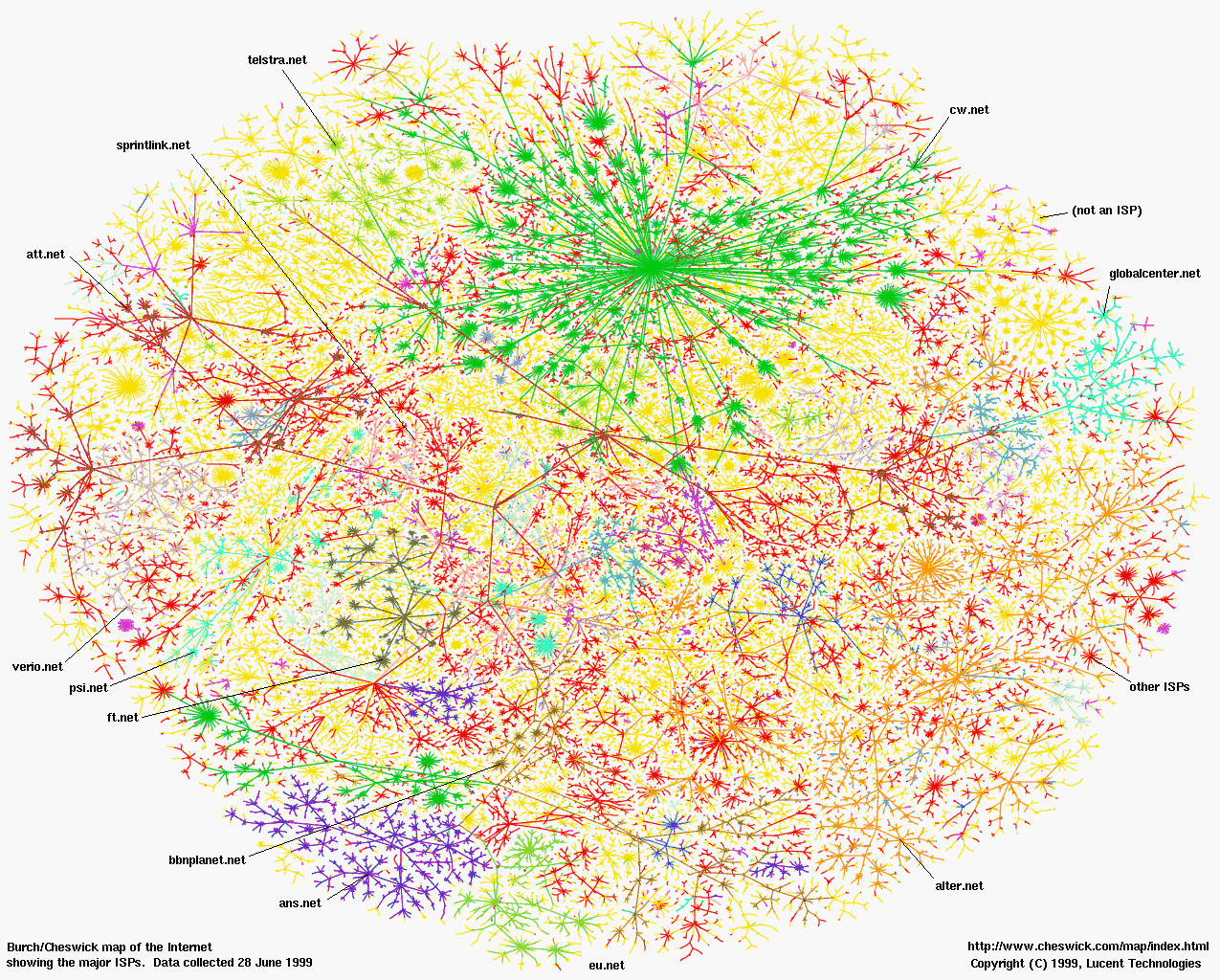
The Internet (Jun. 1999)

Notes

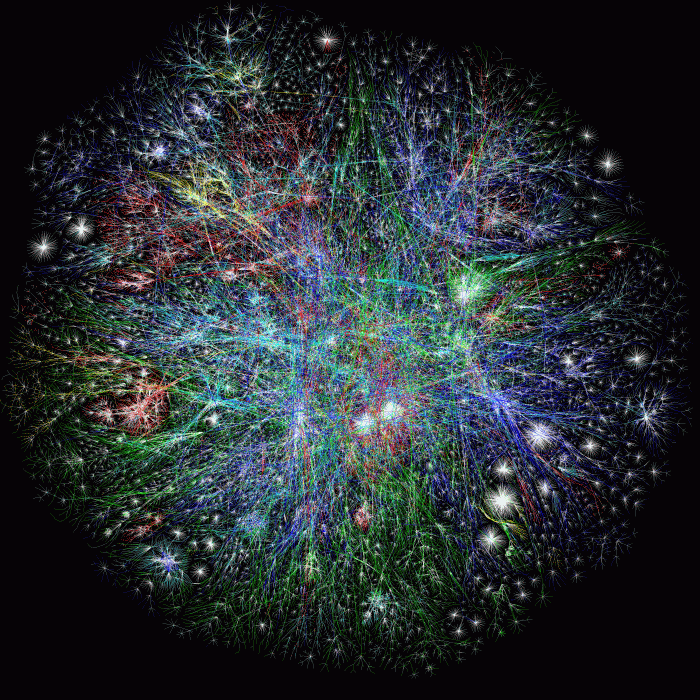
The Internet (2010)

Source: 2010 Map of the Global Internet by Cisco Systems
Notes: find network image of brain, mushroom and others.

The Cloud


from A prehistory of the Cloud (pX)
"situate a network... within the same epistemic space as something that constantly fluctuates and is impossible to know"
A prehistory of the cloud: "situate a network... within the same epistemic space as something that constantly fluctuates and is impossible to know"