"As We May Think" by Vannevar Bush (1945)
Bush was director of the US Office of Scientific Research and Development during World War II, overseeing the Manhattan Project, radar, and weapons research. The essay was written at the war's end. Scientists had produced an enormous body of knowledge; the question was what to do with it next. The memex was imagined as a personal tool for an individual researcher, not a public network, not shared. One machine/private library/usr.
Anticipates the information society.Imagines a device called "memex" based on technologies thought to be near-future advances:
Technology:
- Dry photography
- Compression, miniaturization
- Voice command
- Computing (logic operation)
"Consider a future device for individual use, which is a sort of mechanized private file and library. .... A memex is a device in which an individual stores all his books, records, and communications, and which is mechanized so that it may be consulted with exceeding speed and flexibility. It is an enlarged intimate supplement to his memory.
It consists of a desk, and while it can presumably be operated from a distance, it is primarily the piece of furniture at which he works. On the top are slanting translucent screens, on which material can be projected for convenient reading. There is a keyboard, and sets of buttons and levers."
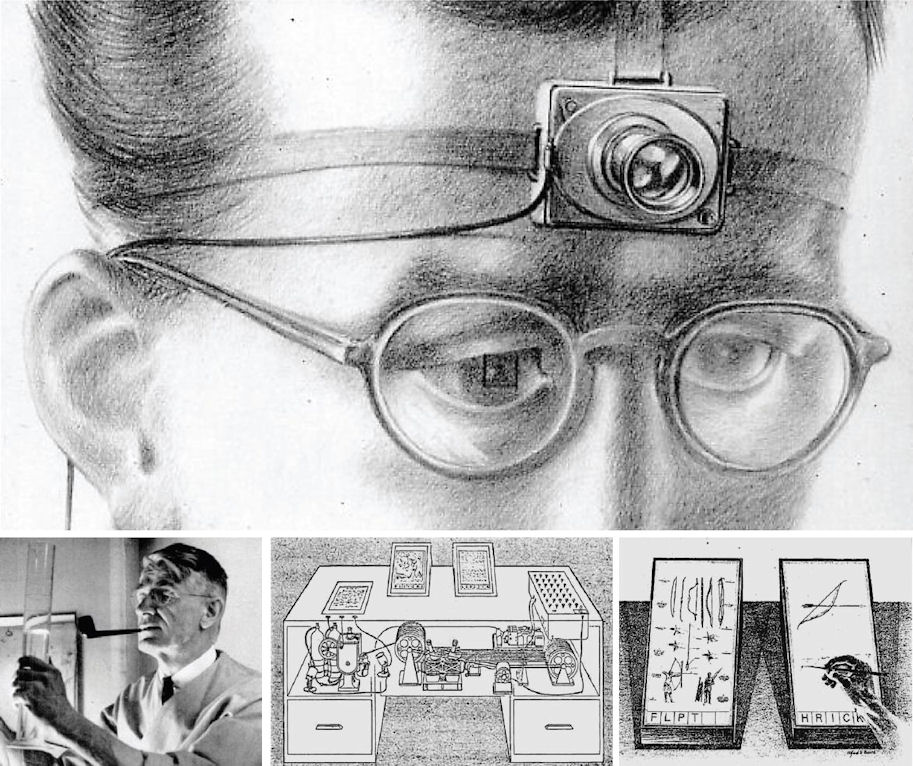
Figures from the September 10,1945 Life magazine article "As We May Think" by Vannevar Bush.
If the user wishes to consult a certain book, he taps its code on the keyboard... A special button transfers him immediately to the first page of the index. Any given book of his library can thus be called up and consulted with far greater facility than if it were taken from a shelf.
...
[Associative indexing]:
All this is conventional.....
The process of tying two items together is the important thing.
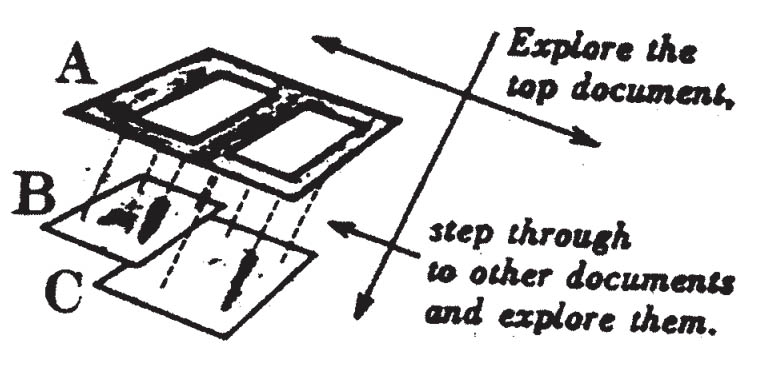
When the user is building a trail, he names it, inserts the name in his code book, and taps it out on his keyboard. Before him are the two items to be joined, projected onto adjacent viewing positions.
Thereafter, at any time, when one of these items is in view, the other can be instantly recalled merely by tapping a button below the corresponding code space. Moreover, when numerous items have been thus joined together to form a trail, they can be reviewed.... It is exactly as though the physical items had been gathered together from widely separated sources and bound together to form a new book.
The owner of the memex, let us say, is interested in the origin and properties of the bow and arrow. Specifically he is studying why the short Turkish bow was apparently superior to the English long bow in the skirmishes of the Crusades. He has dozens of possibly pertinent books and articles in his memex. First he runs through an encyclopedia, finds an interesting but sketchy article, leaves it projected. Next, in a history, he finds another pertinent item, and ties the two together. Thus he goes, building a trail of many items. Occasionally he inserts a comment of his own, either linking it into the main trail or joining it by a side trail to a particular item. When it becomes evident that the elastic properties of available materials had a great deal to do with the bow, he branches off on a side trail which takes him through textbooks on elasticity and tables of physical constants. He inserts a page of longhand analysis of his own. Thus he builds a trail of his interest through the maze of materials available to him.
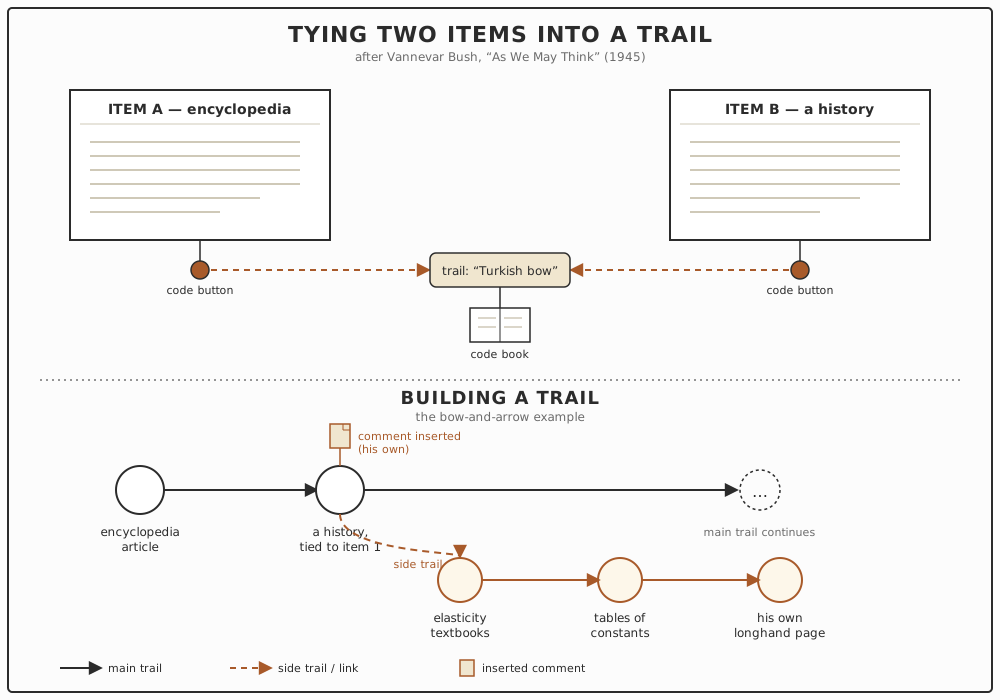
Diagram (not from the 1945 article) illustrating the trail-building process described above.
Several years later, his talk with a friend turns to the queer ways in which a people resist innovations, even of vital interest. He has an example.... In fact he has a trail on it. A touch brings up the code book. Tapping a few keys projects the head of the trail. A lever runs through it at will, stopping at interesting items, going off on side excursions. It is an interesting trail, pertinent to the discussion. So he sets a reproducer in action, photographs the whole trail out, and passes it to his friend for insertion in his own memex, there to be linked into the more general trail.
Q: what do we have today?
Notes