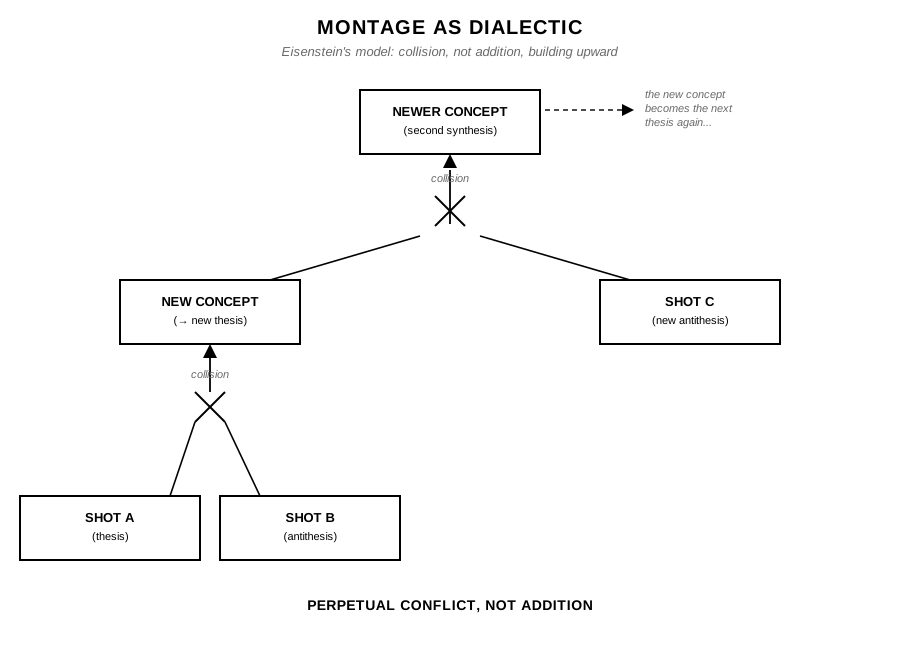
Before Eisenstein, there's Kuleshov. Lev Kuleshov took one shot of actor Ivan Mozzhukhin's face, expression neutral, and cut it against three different follow-up shots: a bowl of soup, a girl in a coffin, a woman on a divan. Audiences reported seeing three different emotions in the exact same shot of the actor's face: hunger, grief, desire, depending only on what came next.
Covered in the assigned video, The History of Cutting: The Soviet Theory of Montage, starting at 4:16.
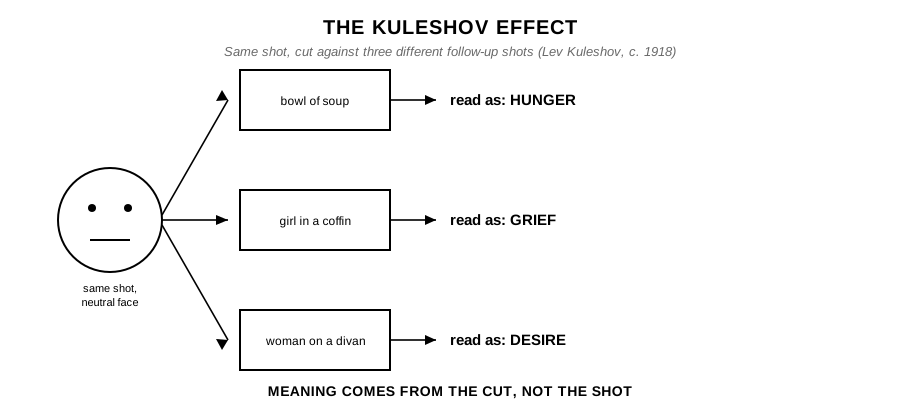
Eisenstein takes Kuleshov's discovery further. For Eisenstein, montage isn't linking two shots so their meanings add up. It's collision: two shots in conflict, cut together, and the collision itself produces a new idea that wasn't in either shot alone.
Shot A (thesis) collides with Shot B (antithesis) at the bottom of the diagram. The collision produces a new concept (synthesis), not a sum, and that synthesis rises to become the next thesis. It collides again, this time with Shot C (a new antithesis), producing a second, higher synthesis at the top. It's a perpetual conflict that keeps climbing, not a settled endpoint.
Watch the worked example in The History of Cutting: The Soviet Theory of Montage, starting at 8:38:
Eisenstein didn't think of montage as one technique. In his 1929 essay "Methods of Montage" he named five, in order of increasing abstraction.
Covered in The History of Cutting: The Soviet Theory of Montage, starting at 9:25.
| Method | What sets the cut |
|---|---|
| Metric | A fixed, measured shot length, set in advance, regardless of what's happening inside the frame |
| Rhythmic | The movement inside the frame itself, cuts land where the on-screen motion says they should |
| Tonal | The emotional tone or mood of a shot, not just its movement |
| Overtonal | Metric, rhythmic, and tonal all working at once, layered into one combined effect |
| Intellectual | Two unrelated shots collide to produce an abstract idea that's in neither shot alone |
Jason Fulford / Aperture On Sight, Lesson 2, "This Equals That."
Nine categories Fulford uses to pair photographs:
Eisenstein's montage is sequential (one shot, then the next, in time) and built on conflict: it's arguing for something.
Fulford's Visual Dominoes works differently. It's spatial, not sequential (two photos sit next to each other at once), and it's built on resemblance, not conflict: a shared color, shape, or texture, not a collision of opposites. It notices a rhyme instead of staging an argument.