|
The Rhodes and |
Writing your story: The application essays |
|

When you consider that only one out of eight or ten applications will survive the first filter, you need to create an application that sings. And you want it to sing opera, not country western.
Many of the best applications indeed "write a story." That is, the selector comes away from the application knowing where you have come from (which may include any hardships you overcame), they see where you are, and they understand where you are going. You want to direct your story in such a way that the U.K. program (which you have researched and with which you have formed personal contact) seems a natural "next chapter" in your narrative. Students often fail to see this narrative element because they answer one question on the application, go for lunch, answer the next, write some e-mail, answer the next, etc. The answers may all be accurate and may individually be strong and thoughtful, but as a whole, they might not leave a lasting impression on the selector. In the end, you want to leave the selector thinking, "I want to meet this person."
That is why an interesting story with a protagonist who shows ongoing growth is important. Several selectors have drawn attention to this story line, this consistency in who you are, how you reach out, what degree you are pursuing and propose to pursue in the U.K., and what the evidence is to back all this up. You want it all to dovetail together as much as possible.
But it's your story. In the end, your autonomy is paramount. Be detailed, be humorous, be colorful, and be honest. Think of varying sentence length, eliminating useless verbiage, avoiding an overuse of "I," and removing that opening set of sentences which sounds so much like a cliché. (The last is incredibly common, even among good writers, because it may be the first time one has ever been asked to write about oneself in a thoughtful and sustained manner.)
To use a metaphor other than "writing a story," think about "painting a portrait." Paula Warrick at the American University in Washington, D.C. uses this fruitful image for the personal statement because it must say as much as possible within a very small space but still retain a clean, cohesive quality. A quality portrait is not just an image but has an agenda. Does your personal statement justify funding to develop your skills and knowledge, and through it are you successfully juggling both primary and secondary themes? A quality portrait is selective in the information it presents, and things that are extraneous don't get brushed in. Does your family background directly relate to your long-term career and academic goals? A quality portrait relies upon conventions. Are you making full use of literary conventions such as the rhetorical techniques of storytelling? Take a moment right now to think of a portrait that most impresses you and think about how its individual components relate to one another. Now ponder ways in which you can create a true likeness of yourself on paper that forwards your agenda, selects what is best about you and relies upon the conventions that can be put to best use. Yet always remember that, aesthetics aside, it must always be a true likeness of yourself. Never exaggerate your claims because this is not the place for caricatures.
The Rhodes' personal statement asks for the candidate's "academic and other interests" (along with reasons for wanting to study a particular program at Oxford), and similarly the Marshall asks for the candidate's "academic and other interests and pursuits" (leaving a separate essay for justifying program and university choice). Both of these thousand-word statements leave much to your discretion, but think through the implications of everything you write. Remember not just to claim your passions but to prove them as well. That is, anyone can claim a passion for physics, but the more attractive candidate justifies his/her passion with, for example, concrete examples of summer research programs at CERN. Anyone can love the environment, but the more attractive candidate is out on Mt. Hood doing impact studies on proposed ski lifts. Demonstrate those academic interests with concrete examples, detailed color or past recognitions of achievements. At the same time, don't go overboard. Remember that you will have an opportunity to list many of your past achievements elsewhere in the application. So be selective, but after being selective, be detailed.
The content of your personal statement is of course most vital, but keep in mind that the way you write up that content in itself demonstrates something about yourself. Are you organized? Are you thoughtful? Are you creative? Are you evidential?
All this is well and good, but you may be asking yourself, "How do I get started?" Answer: Just start. Consider free writing at first about the significant moments in your life. Don't worry about punctuation and refinements. Ask yourself what is unusual, special or distinctive about you. What drives you? What do you care about, and what are you doing about it? Some people work better starting from lists of things they've done, arranging them in hierarchical groups of importance to them. Lay out your CV, your roster of past coursework, your extra-curricular activities, your list of passions and so forth in front of you, and then sit back, looking for a common theme. Don't write to impress, and be honest. Finally, don't be attached to anything you've written as the first drafts rarely resemble the last ones.
The Rhodes, Marshall and Mitchell personal statements are limited to 1000 words, whereas the Gates is set at 500 words.
In the past, I ended this web page on application essays with a warm invitation to utilize me, your other teachers and friends by getting us to read rough drafts and soliciting comments from us. Yet the best help we could offer you was limited to being a devil’s advocate or inquisitor, questioning your assumptions and making you think through the gaps. “It is your own work, and the comments people give you should really be limited to giving you questions to consider or asking you to analyze certain points you’ve raised,” I wrote. “It cannot be overemphasized that this personal statement is your personal statement.” Specifically in terms of the Rhodes scholarship, we must now restrict our help even further because, in 2014, the American secretary of the Rhodes Trust and the warden of Rhodes House sent a letter of concern to all fellowship advisors that focused on the originality of the personal statement:
Many essays are now edited extensively and repeatedly by advisors, fellowship offices, university instructors, family and others. We are no longer confident that the essays reflect the writing ability and style of the applicants, nor, even more important, that they reflect accurately applicants' true personal goals, values and aspirations. Many essays have become formulaic and predictable, mirroring what we presume is a general, albeit mistaken picture of what a "good" Rhodes essay should look like. There is no such model.
Hence you will be asked to append this statement to your Rhodes essay:
I attest that this essay is my own work and is wholly truthful. Neither it nor any earlier draft has been edited by anyone other than me, nor has anyone else reviewed it to provide me with suggestions to improve it. I understand that any such editing or review would disqualify my application.
I sincerely sympathize with this problem. During my brief stints judging the Rhodes state and regional competitions, we regularly received professional, highly polished personal essays from certain institutions that made their candidates sound walk-on-water marvelous, but when the candidates arrived for the interviews, their walk didn’t match their talk. Those candidates were taking interview opportunities away from others whose essays were not quite so highly polished even though they would have been great candidates.
We will of course abide by these even tighter restrictions than we had already placed upon ourselves, although I must personally admit my sincere regret in not being able to help you at all. I see this process, not just as a way of identifying future Rhodes scholars, but also as a teaching moment in which we can help you think through how you describe yourself in general. As stated on this website’s home page, our goal has never been either to groom you or to pour you into a model template. Yet we’ll still try to help you every other way we can.
And so I can only offer my advice long before you put pen to paper. Write your essay, and then walk away from it for a while. Reread the above general admonishments about organization and evidence, concision and storytelling, asking yourself if your essay achieves these kinds of goals. Rewrite and repeat. Rewrite and repeat. Rewrite and repeat. Writing this essay requires a lot of blood, sweat and tears, but the process can also be a great deal of fun as you give voice to your passions. It is hoped your essay will rival Carmen.
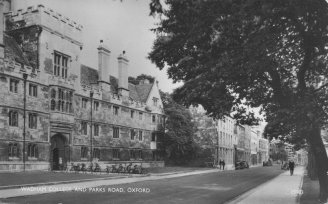
Wadham College, Oxford |
|
||
|
|
