|
The Rhodes and |
Courtney S. |
|

Courtney: Know your interviewers in advance
The Rhodes application process is long, tedious, and oftentimes frustrating. It is also tremendously rewarding, even for a person like myself who did not end up with a ticket to Oxford. My goal here is not to reiterate the details of the application process. Instead, I hope to provide some of the information that I wish I had known (or taken to heart) before applying…
Internal Application
For me, the hardest part about applying for the Rhodes was asking people for recommendations. I felt sheepish asking people, especially professors, to write letters of support. However, I found my professors to be supportive and willing to help with my application. (I later learned from Ken that the college president actually instructs professors to be supportive… So, you really have nothing to fear!) Also, bear in mind that while you only need two recommendations for the internal application, you will need 6-8 for the external application. As the state deadline is only about two weeks after the internal deadline, you would be very wise to begin approaching your other referees early.
After completing the internal application, potential candidates are invited for an internal interview with the fellowships and awards committee. I found this interview to be very much unlike the state-level interview. Having read Derek Lyons’ description of Rhodes interviews, I went there prepared for battle, but instead encountered a friendly group of professors and staff members. I think there were around eight interviewers present—Jo Cannon, Julie Kern-Smith, Ginny Hancock, Ken Brashier, and about four professors who serve on the F&A committee. Ken asked a few pointed questions, but other than that, it was mellow. I think the committee mainly wanted me to explain in greater detail the information from my application.
External Application
The Written Materials
Ken Brashier (the head of the F&A committee [Rhodes and Marshall process] the year I applied) helped my application tremendously. He always made time to meet with me and go over rough drafts, pointing out with great detail how the application could be improved. My friends provided helpful comments as well—especially since mine are brutally honest. Speaking with 20-20 hindsight, I can give the following advice: Don’t wait until you’ve passed the “internal” deadline to start producing serious drafts of applications. After the internal application, it’s a whirlwind trying to get things put together.
The Practice Interviews
The F&A Committee arranges a series of practice interviews for the candidates it endorses. I found them very instructional (and painful). It’s hard to analyze how you speak and present yourself—especially for someone like myself whose instruction was to “be more natural.” The interviews are helpful, but one should be careful not to become too practiced. Also, although only one question from the practice interviews reappeared in my actual interview, the practice interviews gave me confidence in my ability to answer questions. In particular, I found the practice interview with the lawyers to be closest to the real thing.
State Interviews
The Dinner
The year I applied, Reed hosted the State interviews. Everything from the dinner to the interviews was held in those small alphabetically lettered rooms in Gray Center. The dinner began with some light mingling. I was one of the last to arrive, placing my coat in a coatroom, donning a pre-labeled nametag, and picking up a glass of ice water (NOT ALCOHOL!) before diving into the festivities.
I should backtrack here and mention that before the dinner, I spent a few days stressing about what to wear. At the dinner (and interviews), most of the candidates dressed quite formally—the men all had suits with jacket and tie; the women wore mostly professional suit-like outfits (though a few of us didn’t wear suits to the dinner). I felt perfectly comfortable in my non-suit and would recommend dressing as formally as your personal comfort allows.
Getting back to the mingling, I found that I enjoyed talking with the other candidates. Certainly there were the social mavens I’d been warned about, but for the most part, I found the group very pleasant. I did feel silly a few times, trying to strike up conversation with the interviewers. But after the initial feelings of “I should be out there asserting myself,” I relaxed and let conversations happen as they might.
After about 15 minutes, the judges signaled that formal introductions should begin. The group formed a circle, the judges lined up in one continuous arc, the candidates arranged in another. One by one the judges introduced themselves, and as they did so, I realized that every last one (well, every last one save one) had been on the committee the year prior. Yep, that’s a big thing I wish I had known: the same people tend to sit on the committee…
Then the candidates began introductions, and most followed their name with some short list of accolades… touting academic prowess, athletic skill, or some other “Rhodes Quality.” I could feel the candidates sizing one another up, which made me want to toot my own horn as I said my name. But, remembering advice from earlier, I resisted and limited my comments to name and proposed program of study. We also received our interview schedule during the introductions. I drew the 8:00 a.m. interview, putting a small damper on my evening. I tried to be cheerful as I looked for my nametag at one of the three tables in the room.
We sat six to a table: four candidates, two interviewers. Every 45 minutes or so, the interviewers would trade tables, allowing each judge to sit at each table. The tables were not ideal, being rectangular as opposed to round, and situated rather closely to one another. I found it excruciatingly difficult to hear the conversation around me. I had the further misfortune of sitting at a table with two of the aforementioned social mavens. Old debate buddies from undergrad, the two did a fair job of monopolizing the interviewers by engaging in rapid debates about topics from yesteryear. However, I did have opportunity to talk every once in a while, and particularly enjoyed the point when Cecil Rhodes came up (thanks Ken for the Cecil bio).
Be sure to pay attention to the judges’ opinions, experiences, and interests during the dinner. Though I didn’t know it at the time, some of the interviewers were, in a sense, prepping us for our interviews the next day. For example, I remember that Dean Henberg wanted to discuss some article he’d read about linguistics—he even dropped the journal title and rough date. I would have been wise to find the article that evening, for at 8:00 a.m. the next morning, Dean Henberg asked me pointed questions that stemmed from his reading. Even if you don’t think the conversations are “interview previews,” knowing about your audience and having established some rapport can inform how you present your answers, or perhaps how you want to qualify or defer your responses.
At around 10:00, Dean Henberg announced that we would adjourn for the day and commence the next morning with interviews. I drove one of the candidates back to her hotel before returning home for a short evening of sleep.
The Interview
As I’ve been subtly (?) complaining about, I had the 8:00 a.m. interview, the first one of the day. And, unfortunately, I made the mistake of going directly from my house (where everyone was sleeping) to the waiting room (where only I would be waiting). The first person I talked to that day was Dean Henberg. That was a mistake. I wish that I had talked to someone—anyone—before going to my interview. It was the morning and, true to form, I was tired and groggy. Throughout my interview, I could feel that my thoughts weren’t clear. I don’t think it was a matter of being unprepared in general. I think it was a matter of being unprepared at 8:00 a.m. Before going to your interview, make it possible to talk with someone. The best thing would be to have a low-key debate, something that gets the mind working and the tongue flapping.
Without further adieu, here are the questions I received, as best I can remember them:
(1a) We see that you’re involved with AWSEM [Advocates for Women in Science, Engineering, and Mathematics]. Now, obviously there’s a need for the program or it wouldn’t exist, but do you believe that having female scientists will influence the results of science?
(1b) But, do you think that women might ask different questions?
(2a) We see you study linguistics but also studied the sciences during your first year at Reed. I’m particularly interested in natural linguistics, or how, as things in nature change and develop, language changes as well. Have you studied historical linguistics?
(2b) Do you see languages being reduced or made less complex over time?
(2c) How about English specifically?
(2d) What about loss of subjunctive?
*(3a) What if you went to Oxford and your roommate said “How about how Bush’s brother threw the election for him?”
(This type of question had appeared in my practice interviews, but never phrased like this one. As a linguistics major who’d dabbled in the sciences, I had no history-type classes that the interviewers could use to justify questions on obscure news events. So for me, the current events questions were limited to the hanging-chad/ dimpled-chad election controversy)
(3b) What do you think we’ve learned from the presidential election?
(4) How do you feel about the growing use of technology? Do you see it inhibiting social development?
(5) One of the criteria for a Rhodes Scholarship is a fondness for and interest in sports. How do you demonstrate this quality?
Waiting
At around 3:00 p.m., the candidates had to re-congregate in the waiting room while the judges made their decision. During the six or seven hours of deliberation, the judges called four kids back for second interviews.
The candidates munched on pizza, shared jokes, and read poetry. Two kids missed their return flights.
I think it was 10:30 p.m. when the judges returned with their decision. They were quite quick about the announcement. They said that it was the toughest round of applicants they had ever seen (I imagine they say something along these lines every year), and read the names of the two students who would continue on. I was happy with who they chose. One of the girls selected had been my “personal favorite” to continue on. Incidentally, both students had received second interviews. Many kids were teary as we all said goodbye and wandered out into the chilly evening.
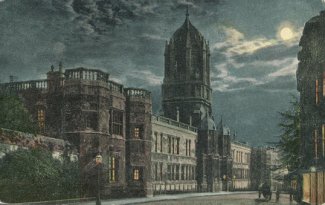
Christ Church, Oxford |
|
||
|
|
