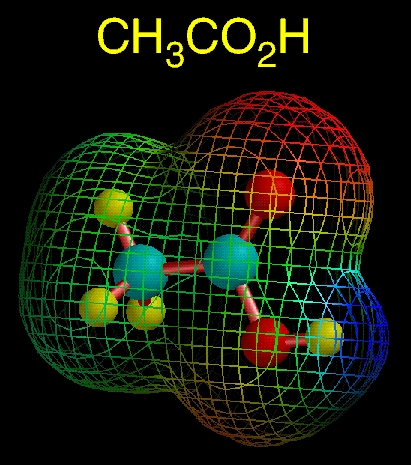
Electrostatic potential maps are useful tools for teaching functional group chemistry. Functional groups usually correspond to either electron-rich or electron-poor sites within a molecule, and are easily identified using an electrostatic potential map.
The figure shows a map of acetic acid, CH3CO2H. The two electron-rich oxygens (RED) and electron-poor hydrogen (BLUE) of the carboxylic acid functional group are easily identified. The functional group's electronic character contrasts sharply with that of the neutral methyl group (GREEN).
The map also reveals subtle molecular features that would be hard to infer from a molecular formula. For example, the map shows that the two oxygens are not equally electron-rich. The carbonyl oxygen (top atom) is more electron-rich than the hydroxyl oxygen (bottom atom). This suggests that the carbonyl oxygen will be a better hydrogen-bond acceptor, a conclusion that is borne out by experiment.
Another interesting observation: the electrostatic potential at the hydroxyl hydrogen of different acids, XCO2H, is strongly correlated with the acids' pKa. Students can discover this relationship for themselves through a "hands-on" modeling experiment (the instructor provides pKa data for various acids and the students build the models), or they can use this relationship to predict the pKa's of "new" acids (the instructor provides a graph of potential vs. pKa and students use this graph and calculated potentials to predict pKa values). Alternatively, I sometimes challenge my students to use this relationship to design a new acid, YCO2H, that should be more acidic than some arbitrary acid of my choosing. "Design" experiments of this type are good teaching tools because they require a combination of innovation, thinking about structure-activity relationships, and "hands-on" modeling.