Resonance is a concept that is central to organic chemistry, yet it causes students many problems. They have trouble visualizing the electronic and geometric characteristics of resonance-stabilized molecules. Also, they have trouble anticipating which molecules will enjoy resonace stabilization. Electrostatic potential maps can provide useful insights into both areas.
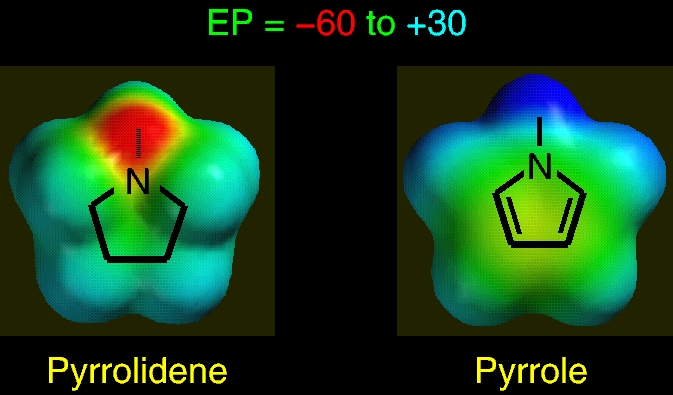
Pyrrolidine (left) is a saturated cyclic amine, C4H9N. The map shows that the hydrocarbon skeleton is relatively neutral, while the region around the nitrogen lone pair is electron-rich (RED). The amine hydrogen is oriented away from the reader so its electronic character cannot be assessed.
Pyrrole (right) is an unsaturated cyclic amine, C4H5N. Because the molecule is aromatic, the molecule adopts a planar geometry and the amine hydrogen (BLUE) is visible. The map clearly shows that, instead of electron density being localized on nitrogen, electron density is distributed around the ring so that the two faces of the ring are relatively electron rich. This is an essential characteristic of resonance-stabilized aromatic molecules.