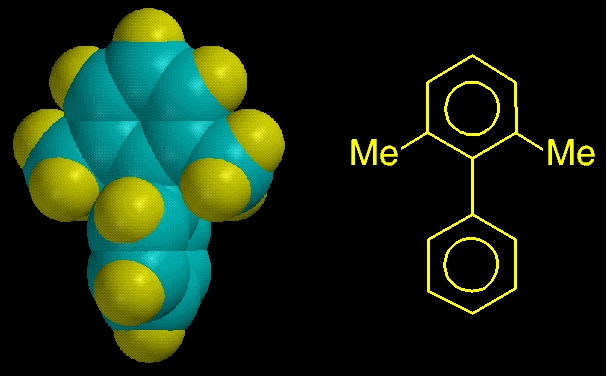
A convenient feature of computer models is that they allow the instructor to select different types of models, and to rapidly change between them. One model that is especially useful, and that has not been used enough in organic chemistry courses, is the space-filling or CPK model.
The figure shows a space-filling model and a line formula for a disubstituted biphenyl. I use models like these to show my students that line formulas do not accurately represent the three-dimensional shape and volume of a molecule. In this case, the line formula suggests that the molecule is planar, while the space-filling model shows that the bottom ring must twist away from the bulky methyl groups. Students immediately grasp the ideas of steric interactions and steric hindrance, i.e., the fact that atom volumes affect molecular shape. Students also learn that they should not take line formulas at face value, and must be prepared to visualize molecules in different ways.
This type of computer modeling is useful because it makes a complicated idea easy to understand. Computer modeling is also useful as a tool for testing understanding. In this case, once I have explained steric interactions and steric hindrance I can "test" student understanding by asking follow-up questions, such as: What happens to the barrier to ring rotation if the methyl groups are replaced by larger or smaller groups? Which of the following groups are larger (or smaller) than a methyl group? (F, Cl, Br, Et, iPr, tBu, Ph) I then use additional computer models to evaluate their answers thus giving them yet more practice at using models.
The point of follow-up questions is not to introduce new and more difficult material into the course, but to deepen understanding of the basic material.